Navigating Withholding Tax on Dividends and Royalties in Germany: A Comprehensive Guide
Understanding Germany's withholding tax regime for dividends and royalties is crucial for international businesses. This guide provides a detailed overview of applicable rates, relief mechanisms, and compliance requirements to ensure efficient cross-border transactions and avoid pitfalls.
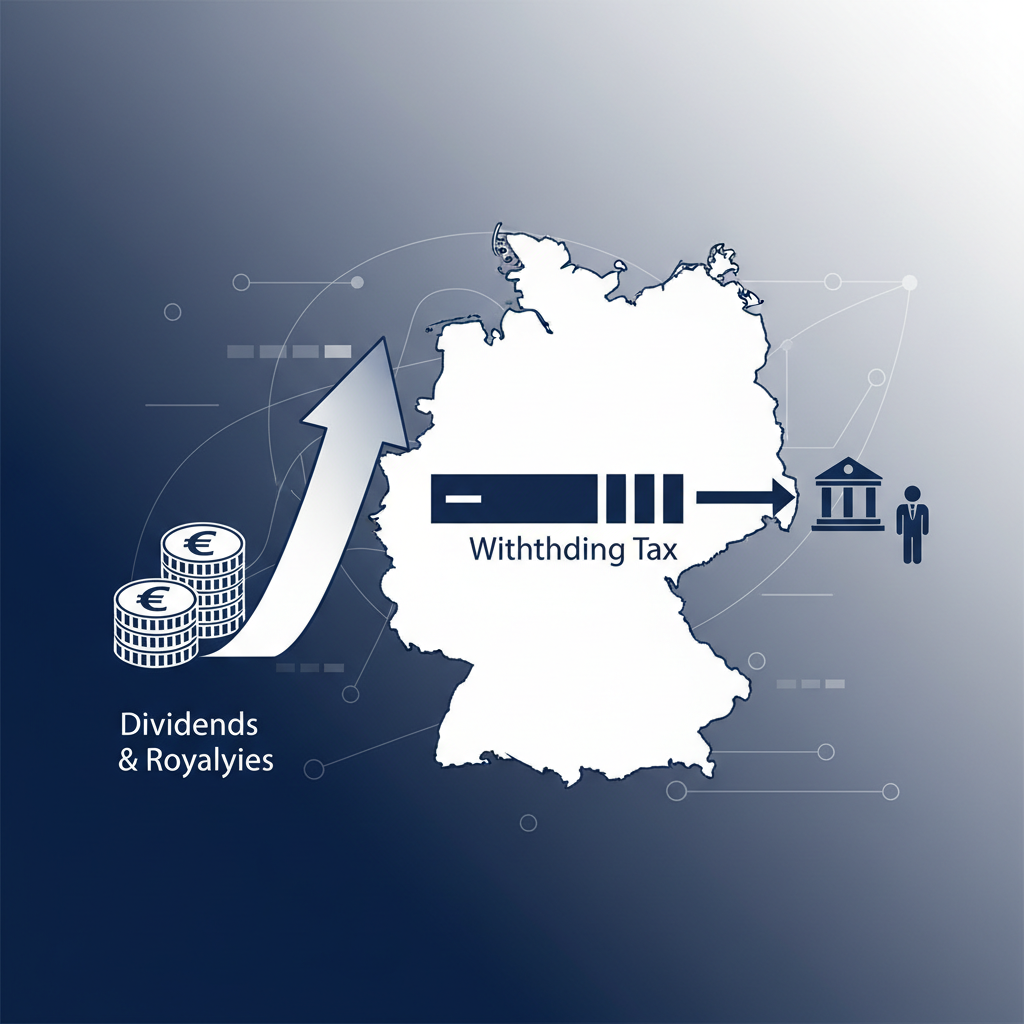
Introduction to Withholding Tax in Germany
Germany, as a major global economy, has a sophisticated tax system that includes withholding taxes on certain types of income paid to non-residents. For international businesses and investors, understanding these regulations is paramount to ensure compliance, optimize tax liabilities, and facilitate smooth cross-border operations. This article focuses specifically on the withholding tax (WHT) applied to dividends and royalties, two common forms of income flow between Germany and other jurisdictions. We will delve into the standard rates, the impact of double taxation treaties (DTTs) and EU directives, the process for claiming relief, and practical considerations for businesses.
Withholding tax, often referred to as 'Quellensteuer' in German, is essentially an advance payment of income tax or corporate income tax levied at source. This means the payer of the income (e.g., a German company distributing dividends or paying royalties) is legally obliged to deduct a certain percentage of the payment and remit it directly to the German tax authorities. The recipient, typically a non-resident entity or individual, then receives the net amount. The primary purpose of WHT is to ensure that income generated within Germany by foreign entities is subject to German taxation, even if the recipient does not have a permanent establishment in the country.
Withholding Tax on Dividends
Dividends distributed by German resident companies to non-resident shareholders are generally subject to German withholding tax. The standard statutory rate for dividends is 25%. Additionally, a solidarity surcharge (Solidaritätszuschlag) of 5.5% of the WHT amount is levied, bringing the effective total statutory withholding tax rate to 26.375% (25% + 5.5% of 25%). This rate applies to both corporate and individual shareholders who are non-residents of Germany.
Impact of Double Taxation Treaties (DTTs)
Germany has an extensive network of double taxation treaties with over 90 countries. These treaties are designed to prevent the same income from being taxed twice in different jurisdictions and often reduce the domestic withholding tax rates. For dividends, DTTs typically reduce the WHT rate to 15% or 5%, depending on the specific treaty and the percentage of shareholding. A 5% rate is commonly granted when the recipient company holds a significant stake (e.g., 10% or 25%) in the German company paying the dividend, reflecting a more substantial business relationship rather than passive investment.
EU Parent-Subsidiary Directive
For dividends paid by a German subsidiary to its parent company located in another EU member state, the EU Parent-Subsidiary Directive (Council Directive 2011/96/EU) often provides for a full exemption from German withholding tax. To qualify for this exemption, several conditions must be met:
- Both the distributing German company and the receiving EU parent company must be resident in an EU member state and subject to corporate income tax without the option of exemption.
- The parent company must hold at least 10% of the capital of the German subsidiary for an uninterrupted period of at least 12 months.
- The companies must not be considered abusive structures under German anti-abuse rules (e.g., the 'treaty shopping' provisions in Section 50d (3) of the German Income Tax Act).
If these conditions are met, the German WHT can be reduced to 0%, significantly simplifying cross-border profit repatriation within the EU.
Withholding Tax on Royalties
Royalties paid by a German resident to a non-resident for the use of intellectual property (such as patents, trademarks, copyrights, or industrial processes) are also generally subject to German withholding tax. The standard statutory rate for royalties is 15%. Similar to dividends, a solidarity surcharge of 5.5% of the WHT amount is added, resulting in an effective total statutory withholding tax rate of 15.825% (15% + 5.5% of 15%).
Impact of Double Taxation Treaties (DTTs) on Royalties
Double taxation treaties play an even more critical role for royalties than for dividends, as many DTTs reduce the German WHT rate on royalties to 0%. This is a common provision, especially for technical services and the use of industrial, commercial, or scientific equipment. However, some treaties may still stipulate a reduced rate of 5% or 10%. It is essential to consult the specific DTT between Germany and the recipient's country of residence to determine the applicable rate.
EU Interest and Royalty Directive
Similar to the Parent-Subsidiary Directive, the EU Interest and Royalty Directive (Council Directive 2003/49/EC) can provide for a full exemption from German withholding tax on royalty payments made between associated companies in different EU member states. The key conditions for this exemption include:
- Both the paying German company and the receiving EU company must be resident in an EU member state and subject to corporate income tax.
- Both companies must be 'associated companies,' meaning one holds directly at least 25% of the capital of the other, or a third EU company holds directly at least 25% of the capital of both for an uninterrupted period of at least two years.
- The payments must not be considered abusive under German anti-abuse rules.
If these criteria are met, the WHT on royalties can be reduced to 0%, facilitating the free flow of intellectual property income within the EU.
Claiming Withholding Tax Relief and Refund Procedures
Navigating the process of claiming WHT relief or refunds is crucial for businesses to benefit from DTTs or EU directives. Generally, there are two main methods:
1. Exemption at Source (Freistellungsverfahren)
This is the preferred method as it avoids the initial deduction of the full statutory WHT. The non-resident recipient applies to the German Federal Central Tax Office (Bundeszentralamt für Steuern – BZSt) for an exemption certificate (Freistellungsbescheinigung). Once granted, the German payer can then apply the reduced treaty rate or the 0% rate directly when making the payment. This certificate is typically valid for a specified period (e.g., three years) and must be presented to the German payer before the payment is made. The application process requires detailed information about the recipient, the German payer, the type of income, and the basis for the reduction (DTT or EU directive).
2. Refund Procedure (Erstattungsverfahren)
If the WHT has already been deducted at the full statutory rate, the non-resident recipient can apply to the BZSt for a refund of the excess tax paid. This application must generally be submitted within four years from the end of the calendar year in which the dividend or royalty was received. The refund application requires proof of the WHT deduction (e.g., a tax certificate from the German payer) and documentation supporting the claim for a reduced rate under a DTT or an exemption under an EU directive. The refund process can be time-consuming, often taking several months, and requires meticulous documentation.
Anti-Abuse Rules (Treaty Shopping)
Germany has stringent anti-abuse rules, particularly Section 50d (3) of the German Income Tax Act, designed to prevent 'treaty shopping' or the artificial insertion of intermediary companies solely to benefit from DTTs or EU directives. If a foreign company is deemed to be merely a conduit for another entity that would not be entitled to the same WHT reduction, the relief may be denied. The BZSt scrutinizes the substance and economic activities of the recipient entity to ensure it has genuine business operations and is not merely a 'letterbox' company. This is a critical consideration when structuring international holdings and licensing agreements.
Practical Considerations and Compliance
For German companies making payments subject to WHT, accurate compliance is essential. This includes:
- Timely Deduction and Remittance: The WHT must be deducted at the correct rate and remitted to the local tax office (Betriebsstättenfinanzamt) by the 10th day of the month following the payment.
- Tax Certificates: German payers are obliged to issue tax certificates (Steuerbescheinigungen) to the non-resident recipients, detailing the gross payment, the WHT deducted, and the net payment. These certificates are crucial for recipients to claim refunds or credits in their home countries.
- Documentation: Maintaining thorough documentation of all payments, WHT deductions, DTT applications, and exemption certificates is vital for potential tax audits.
For non-resident recipients, proactive planning is key. Before entering into agreements involving dividends or royalties from Germany, it is advisable to:
- Review Applicable DTTs: Understand the specific provisions of the DTT between Germany and your country of residence.
- Assess EU Directive Eligibility: Determine if your corporate structure qualifies for exemptions under the Parent-Subsidiary or Interest and Royalty Directives.
- Apply for Exemption Certificates: Where possible, apply for exemption at source to avoid cash flow disadvantages and the lengthy refund process.
- Seek Professional Advice: German tax law is complex. Engaging with tax advisors specializing in international taxation can help ensure compliance and optimize tax efficiency.
Conclusion
Withholding tax on dividends and royalties in Germany represents a significant aspect of international business operations. While the statutory rates can be substantial, Germany's extensive network of double taxation treaties and its adherence to EU directives provide ample opportunities for reducing or even eliminating these taxes. However, navigating the intricate rules, particularly the anti-abuse provisions, requires careful planning, meticulous documentation, and often, expert guidance. By understanding the standard rates, leveraging available relief mechanisms, and adhering to the correct procedures for claiming exemptions or refunds, businesses can effectively manage their tax liabilities and ensure efficient cross-border financial flows with Germany. Proactive engagement with the German tax authorities and professional advisors is the most reliable path to compliance and tax optimization in this complex landscape.