Navigating VAT Registration and Rates in Austria: A Comprehensive Guide for Businesses
Understanding Austria's Value Added Tax (VAT) system is crucial for any business operating or planning to operate within its borders. This article provides a detailed overview of VAT registration requirements, applicable rates, and compliance obligations, offering practical insights for entrepreneurs and professionals.
Introduction to Austrian VAT
Value Added Tax (VAT), known as Umsatzsteuer (USt) in Austria, is a consumption tax levied on most goods and services sold for use or consumption within the country. As a member state of the European Union, Austria's VAT system is largely harmonised with EU directives, though specific rates and certain procedural aspects are determined at the national level. For businesses, comprehending the intricacies of Austrian VAT is not merely a compliance task but a fundamental aspect of financial planning and operational efficiency. Failure to comply with VAT regulations can lead to significant penalties, including fines and interest charges, making a thorough understanding indispensable for anyone conducting business in or with Austria.
This comprehensive guide aims to demystify the Austrian VAT landscape, providing entrepreneurs, international businesses, and financial professionals with the essential knowledge required to navigate registration, apply correct rates, and fulfill their reporting obligations. We will delve into who needs to register, the various VAT rates, the registration process, and ongoing compliance requirements, offering actionable insights to ensure smooth and lawful operation.
Who Needs to Register for VAT in Austria?
VAT registration in Austria is mandatory for a broad range of businesses and individuals, both resident and non-resident, under specific circumstances. The primary trigger for VAT registration is typically exceeding a certain turnover threshold, but other factors can also necessitate registration.
Domestic Businesses and the Small Business Exemption
For businesses established in Austria, the general rule is that if their annual turnover exceeds EUR 35,000 (net), they are obligated to register for VAT. This threshold applies to the total net turnover from taxable supplies of goods and services within Austria. Businesses with a turnover below this threshold are generally considered 'small businesses' (Kleinunternehmer) and are exempt from VAT, meaning they do not charge VAT on their sales and cannot reclaim input VAT on their purchases. However, even small businesses can voluntarily opt for VAT registration, which might be advantageous if they primarily supply to other businesses and wish to reclaim input VAT.
Non-Resident Businesses and International Transactions
Non-resident businesses, meaning those without a fixed establishment in Austria, may also be required to register for Austrian VAT if they engage in certain activities. Common scenarios include:
- Distance Selling: If a non-resident business sells goods to private individuals in Austria and exceeds the EU-wide distance selling threshold of EUR 10,000 (for total EU sales), they must register for VAT in Austria or use the One-Stop Shop (OSS) scheme. The OSS scheme simplifies compliance for B2C supplies of goods and services across the EU.
- Storage of Goods: Holding goods in a warehouse or consignment stock in Austria for subsequent sale to Austrian customers.
- Domestic Supplies: Making taxable supplies of goods or services in Austria to customers who are not liable to reverse charge (e.g., B2C supplies or B2B supplies where the reverse charge mechanism does not apply).
- Intra-Community Acquisitions: Acquiring goods from another EU member state into Austria for business purposes, if the acquisition threshold is exceeded (though often the reverse charge applies).
- Organising Events: Hosting conferences, trade fairs, or other events in Austria where admission fees are charged.
It is crucial for non-resident businesses to assess their activities carefully, as the absence of a physical presence does not automatically exempt them from Austrian VAT obligations. In many cases, a non-resident business will need to appoint a fiscal representative in Austria, particularly if they are from a non-EU country, to handle their VAT obligations.
Austrian VAT Rates
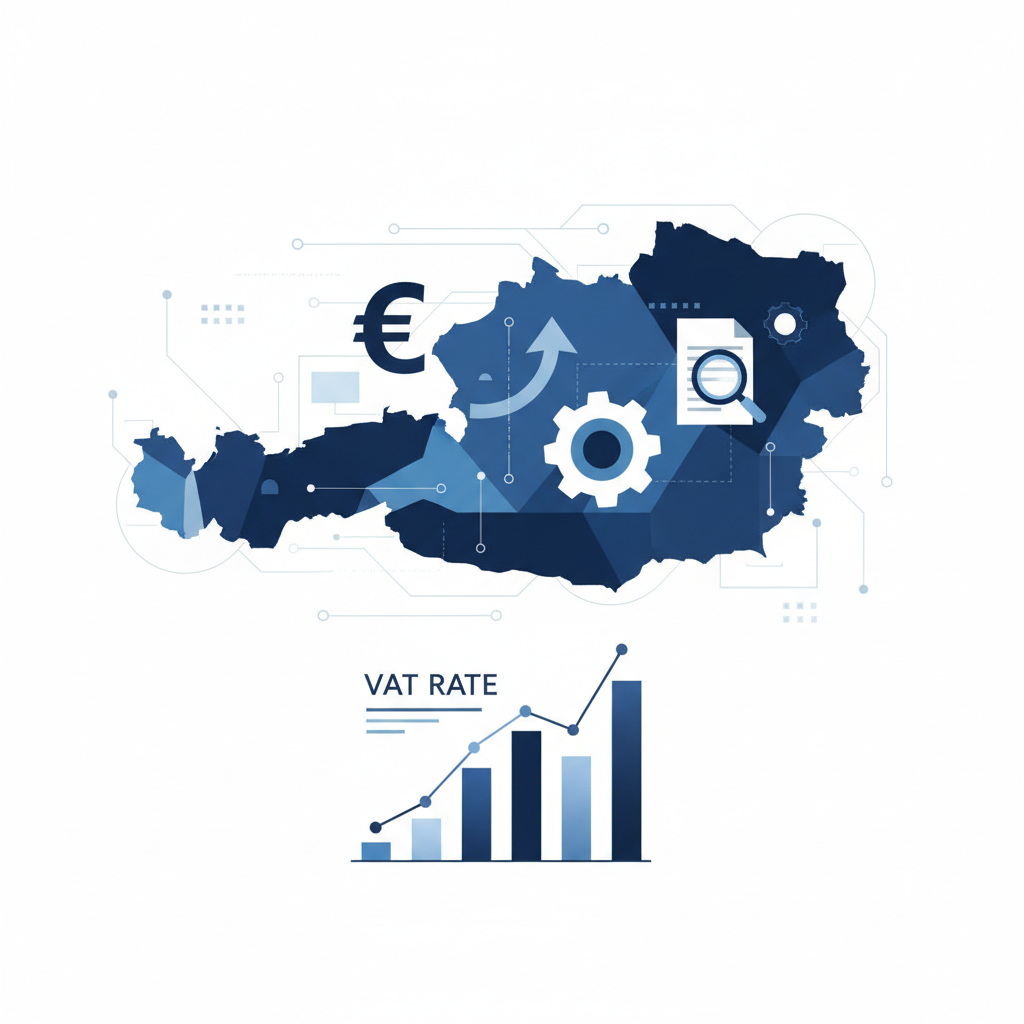
Austria applies a multi-rate VAT system, comprising a standard rate, reduced rates, and a super-reduced rate, along with certain exemptions. Understanding which rate applies to specific goods and services is critical for accurate invoicing and compliance.
Standard VAT Rate
The standard VAT rate in Austria is 20%. This rate applies to the vast majority of goods and services that are not subject to a reduced rate or an exemption. Examples include most manufactured goods, general retail items, professional services, and restaurant services (excluding certain beverages).
Reduced VAT Rates
Austria has two main reduced VAT rates:
-
10% Reduced Rate: This rate is applied to essential goods and services, including:
- Foodstuffs (excluding alcoholic beverages)
- Books, newspapers, magazines
- Public transport services (e.g., bus, train, tram)
- Accommodation services (hotels, guesthouses)
- Admissions to cultural events (theatre, concerts, museums)
- Pharmaceuticals and medical devices
- Waste collection and water supply
-
13% Reduced Rate: This rate was introduced for specific sectors and applies to:
- Admissions to sporting events
- Admissions to cinemas
- Certain artistic and cultural performances (e.g., circuses, zoos)
- Wine from the producer (farm gate sales)
- Live plants and flowers
- Firewood
- Domestic flights
Super-Reduced and Zero Rates
While Austria does not have a general super-reduced rate below 10%, certain supplies are effectively zero-rated or exempt:
- Zero-rated supplies include intra-Community supplies of goods (B2B sales to other EU member states), exports of goods outside the EU, and certain international transport services. Although zero-rated, these supplies are still considered taxable and require reporting, allowing businesses to reclaim related input VAT.
- Exempt supplies include certain financial and insurance services, healthcare services, educational services, and specific real estate transactions. Businesses making exempt supplies cannot reclaim input VAT related to these activities.
VAT Registration Process and Compliance
Registering for VAT in Austria involves submitting an application to the relevant tax authority. The process requires careful preparation and adherence to specific steps.
Application and Documentation
Businesses must apply for a VAT identification number (Umsatzsteuer-Identifikationsnummer, UID-Nummer) from the local tax office (Finanzamt) responsible for their place of business or, for non-residents, the Finanzamt Graz-Stadt. The application typically involves submitting Form Verf 19 (for domestic businesses) or Verf 26 (for non-resident businesses). Required documentation generally includes:
- Proof of identity (e.g., passport for individuals, articles of association for companies).
- Proof of business activity (e.g., business registration, trade licence).
- Bank account details.
- Details of planned business activities and expected turnover.
- For non-resident businesses, a certificate of good standing from their home country's tax authority and, if applicable, details of their fiscal representative.
The processing time for a VAT registration can vary, but typically ranges from a few weeks to a couple of months, depending on the completeness of the application and the complexity of the business structure.
VAT Reporting and Payment Obligations
Once registered, businesses have ongoing VAT compliance obligations:
- VAT Returns (Umsatzsteuervoranmeldung - UStVA): Businesses must periodically submit VAT returns, typically monthly or quarterly, depending on their annual turnover. The UStVA reports total sales, purchases, and the resulting VAT liability or reclaim. The deadline for submission and payment is generally the 15th day of the second month following the reporting period (e.g., for January, due by March 15th).
- Annual VAT Return (Umsatzsteuererklärung - UStE): An annual VAT return summarises all transactions for the fiscal year and must be submitted by June 30th of the following year (or by March 31st if filed manually).
- Intrastat and EC Sales Lists: Businesses involved in intra-Community trade (buying or selling goods/services to other EU member states) may need to file Intrastat declarations (for goods movements) and EC Sales Lists (Zusammenfassende Meldung - ZM) for B2B supplies of goods and certain services, reporting details of their transactions with other EU VAT-registered businesses.
- Invoicing Requirements: Austrian VAT law dictates specific information that must be included on invoices, such as the seller's and buyer's VAT numbers, the date of supply, a description of goods/services, the net amount, the VAT rate applied, and the VAT amount.
Penalties for Non-Compliance
Non-compliance with Austrian VAT regulations can result in significant penalties. These may include late filing penalties, late payment penalties, and interest charges on overdue amounts. Intentional evasion or gross negligence can lead to more severe sanctions, including criminal charges in extreme cases. Therefore, meticulous record-keeping and timely submission are paramount.
Conclusion
Navigating the Austrian VAT system requires a comprehensive understanding of its registration requirements, diverse rates, and stringent compliance obligations. For both domestic and international businesses, proactive engagement with these regulations is key to avoiding penalties and ensuring smooth financial operations. From determining the necessity of registration based on turnover thresholds or specific activities, to correctly applying the standard, reduced, or zero rates, and diligently fulfilling reporting duties, each step demands careful attention.
Entrepreneurs and business professionals should consider seeking expert advice from tax consultants specialising in Austrian VAT law, especially when dealing with complex international transactions or novel business models. Staying informed about legislative changes and leveraging digital tools for VAT management can significantly streamline compliance efforts. By embracing a proactive and informed approach, businesses can effectively manage their VAT responsibilities in Austria, contributing to their overall success and legal standing within the European market.