
Mauritius Company Formation: A Comprehensive Guide to Business Entities
Mauritius has emerged as a leading jurisdiction for international business, offering a diverse range of company structures tailored to various operational needs. This article provides an in-depth exploration of the types of business entities available, outlining their characteristics, regulatory frameworks, and strategic advantages for entrepreneurs and investors.
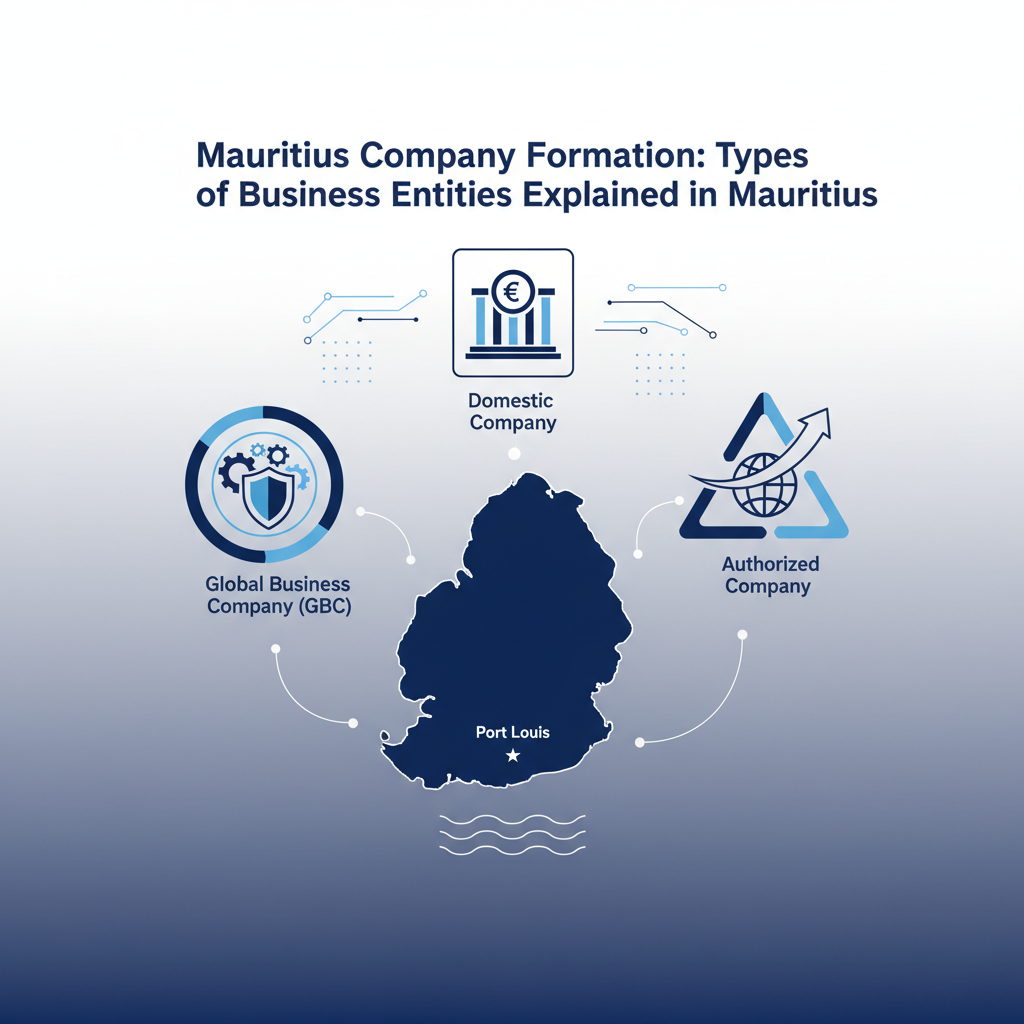
Mauritius Company Formation: A Comprehensive Guide to Business Entities
Mauritius, an island nation strategically located in the Indian Ocean, has meticulously cultivated its reputation as a robust and reputable international financial centre. Its stable political environment, strong legal framework based on both English common law and French civil law, and a network of double taxation avoidance agreements (DTAAs) make it an attractive destination for entrepreneurs, multinational corporations, and investors seeking to establish a presence in Africa and beyond. Understanding the various types of business entities available for company formation in Mauritius is crucial for making an informed decision that aligns with specific business objectives, regulatory compliance, and tax efficiency.
Overview of the Mauritian Business Landscape
The Mauritian government, through its financial services regulator, the Financial Services Commission (FSC), has implemented progressive legislation to foster a conducive environment for both local and international businesses. The Companies Act 2001 is the primary legislation governing company incorporation and operation, while specific acts like the Financial Services Act 2007 and the Securities Act 2005 regulate various aspects of the financial services sector. The country's commitment to transparency and adherence to international best practices, including anti-money laundering (AML) and combating the financing of terrorism (CFT) regulations, further enhances its credibility.
Key advantages of establishing a business in Mauritius include:
- Strategic Location: A gateway for investment into Africa and Asia.
- Favourable Tax Regime: Competitive corporate tax rates and an extensive DTAA network.
- Political and Economic Stability: A democratic government and a growing economy.
- Skilled Workforce: A well-educated, bilingual (English and French) labour force.
- Robust Regulatory Framework: Strong legal and regulatory oversight.
- Ease of Doing Business: Streamlined incorporation processes and business-friendly policies.
Types of Business Entities in Mauritius
Mauritius offers a variety of legal structures, each designed to cater to different operational scales, ownership preferences, and strategic goals. The choice of entity significantly impacts legal liability, tax obligations, administrative burden, and public disclosure requirements.
1. Global Business Companies (GBC)
The Global Business Company (GBC), formerly known as a GBL1 company, is perhaps the most popular vehicle for international investment and structuring. A GBC is a resident company in Mauritius for tax purposes and can therefore benefit from Mauritius's extensive DTAA network, subject to meeting substance requirements. To qualify as a GBC, a company must demonstrate 'substance' in Mauritius, which typically involves:
- Having at least two resident directors of appropriate calibre.
- Maintaining its principal bank account in Mauritius.
- Keeping its accounting records at its registered office in Mauritius.
- Appointing a company secretary who is a resident of Mauritius.
- Having its board meetings in Mauritius with at least two directors physically present.
- Conducting its core income generating activities in or from Mauritius.
GBCs are ideal for activities such as international investment, asset management, fund management, holding companies, and intellectual property management. They are subject to a corporate tax rate of 15%, but can benefit from an 80% partial exemption on certain income streams (e.g., foreign-source dividends, interest, and intellectual property income), effectively reducing the tax rate to 3% on qualifying income, provided they meet specific conditions for substance and core income generating activities. This makes the GBC a highly attractive option for international tax planning.
2. Authorised Company (AC)
The Authorised Company (AC), previously known as a GBL2 company, is a non-resident company for tax purposes in Mauritius. This means it is not eligible to access Mauritius's DTAA network. An AC is primarily used for activities where the company's control and management are exercised outside Mauritius. It is typically suitable for specific activities such as:
- Holding non-Mauritian assets (e.g., real estate, shares).
- International trading.
- Consultancy services.
- E-commerce activities where the operational base is outside Mauritius.
An AC is exempt from corporate tax in Mauritius, as its income is not considered Mauritian-sourced. However, it must still comply with AML/CFT regulations and file an annual return with the FSC. The requirements for an AC are less stringent regarding substance compared to a GBC, as its management and control are outside Mauritius. It still requires a registered agent and office in Mauritius.
3. Domestic Company
Domestic companies are incorporated under the Companies Act 2001 and are primarily intended for businesses operating within the Mauritian economy. These companies are resident for tax purposes and are subject to the standard corporate tax rate of 15% on their chargeable income, with certain exemptions and incentives available for specific sectors like manufacturing, agriculture, and innovation. Common forms include:
- Company Limited by Shares: The most common type, where shareholders' liability is limited to the amount unpaid on their shares.
- Company Limited by Guarantee: Used for non-profit organisations, where members' liability is limited to the amount they undertake to contribute in the event of winding up.
- Unlimited Company: Where members' liability is unlimited.
Domestic companies are suitable for local businesses, subsidiaries of foreign companies targeting the Mauritian market, and companies engaged in activities that require a physical presence and local operational focus within Mauritius.
4. Limited Partnership (LP) and Limited Liability Partnership (LLP)
Mauritius also offers partnership structures that provide flexibility for certain types of businesses, particularly in investment and professional services.
-
Limited Partnership (LP): An LP must have at least one general partner with unlimited liability and at least one limited partner whose liability is limited to their capital contribution. LPs can be structured as either domestic LPs or global business LPs (GBLP), with the latter being tax resident and eligible for DTAA benefits if they meet substance requirements. They are commonly used for private equity funds, venture capital funds, and other collective investment schemes.
-
Limited Liability Partnership (LLP): An LLP provides limited liability to all partners, similar to a company, while retaining the flexibility of a partnership structure. It is often preferred by professionals such as lawyers, accountants, and consultants. LLPs are governed by the Limited Liability Partnerships Act 2009.
5. Protected Cell Company (PCC)
A Protected Cell Company (PCC) is a single legal entity comprising a core and several


