
How to Register a Company in Mauritius: A Complete Step-by-Step Guide for Global Entrepreneurs
Mauritius has emerged as a premier jurisdiction for international business, offering a stable political environment, robust legal framework, and attractive tax incentives. This comprehensive guide provides a step-by-step walkthrough for registering a company in Mauritius, covering everything from legal structures to compliance requirements and ongoing obligations. Entrepreneurs looking to establish a presence in this dynamic island nation will find practical insights and actionable advice.
How to Register a Company in Mauritius: A Complete Step-by-Step Guide for Global Entrepreneurs
Mauritius, an island nation in the Indian Ocean, has meticulously cultivated its reputation as a leading international financial centre and an attractive jurisdiction for company formation. Its strategic location, stable political and economic environment, well-regulated financial services sector, and a network of Double Taxation Avoidance Agreements (DTAAs) make it a compelling choice for entrepreneurs and multinational corporations seeking to establish a global presence. Registering a company in Mauritius offers access to African markets, a favourable tax regime, and a sophisticated legal system based on both English common law and French civil law. This guide provides a detailed, step-by-step overview of the process, designed to equip prospective business owners with the knowledge required for successful incorporation.
Understanding Company Structures in Mauritius
Before embarking on the registration process, it is crucial to understand the various legal structures available in Mauritius, as the choice will significantly impact operational flexibility, regulatory compliance, and tax obligations. The most common types of companies registered in Mauritius include:
1. Global Business Company (GBC)
Previously known as Global Business Category 1 (GBC1), the GBC is designed for companies undertaking business primarily outside Mauritius. To qualify as a GBC, a company must demonstrate 'substance' in Mauritius, meaning it must be managed and controlled from the island, have a certain level of expenditure, and employ a number of qualified staff locally. GBCs benefit from Mauritius's extensive DTAA network, making them ideal for international investment, holding structures, and cross-border trade. They are subject to a corporate tax rate of 15%, but partial exemptions can reduce the effective rate significantly for certain income streams.
2. Authorised Company (AC)
An Authorised Company (formerly Global Business Category 2 or GBC2) is a company whose core business activities and control are outside Mauritius. Unlike a GBC, an AC does not benefit from Mauritius's DTAA network and is treated as a non-resident for tax purposes, meaning it is exempt from corporate tax in Mauritius. ACs are typically used for asset holding, international trading, and consultancy services where DTAA benefits are not a primary concern. They are required to file an annual return and maintain accounting records.
3. Domestic Company
A domestic company is primarily engaged in business activities within Mauritius. These companies are fully subject to Mauritian tax laws and regulations, including a corporate tax rate of 15% on their chargeable income. They are suitable for businesses targeting the local Mauritian market or those with significant local operations.
4. Limited by Shares (LBS)
This is the most common form of company, where the liability of shareholders is limited to the amount, if any, unpaid on their shares. Both GBCs and domestic companies can be formed as LBS entities.
The Company Registration Process: A Step-by-Step Guide
The company registration process in Mauritius is overseen by the Registrar of Companies, which falls under the purview of the Corporate and Business Registration Department (CBRD). While the process is streamlined, engaging with a professional management company or corporate service provider is highly recommended to ensure compliance and efficiency.
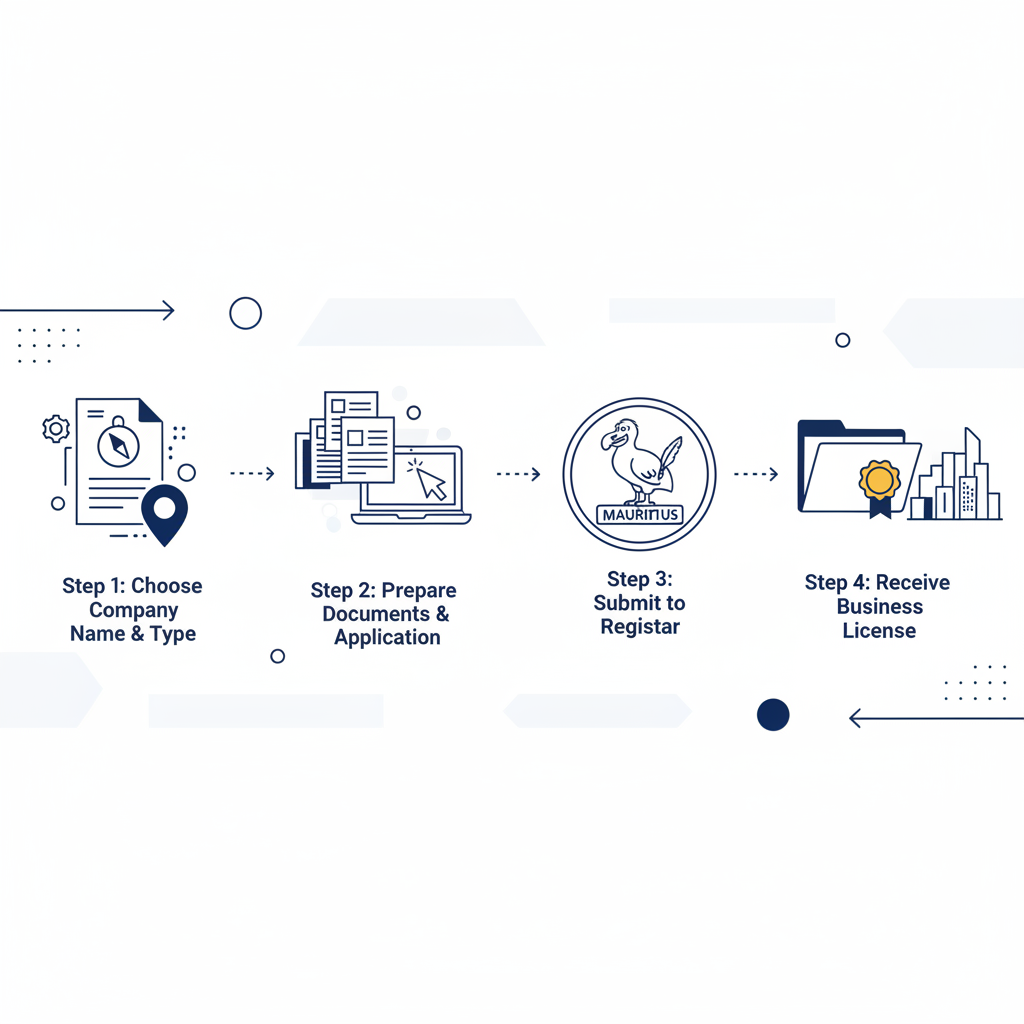
Step 1: Name Reservation
The first critical step is to reserve your company name. This involves submitting an application to the CBRD to check the availability of the proposed name. The name must be unique and not offensive or misleading. It typically takes 1-2 working days for approval. Once approved, the name is reserved for a period of two months, during which the incorporation documents must be filed.
Step 2: Preparation of Incorporation Documents
Once the name is reserved, the following documents must be prepared:
- Application for Incorporation (Form 1): This form provides basic details about the company, including its name, type, registered office address, and proposed activities.
- Constitution (Articles of Association): This document outlines the rules governing the company's internal management and the rights and responsibilities of its shareholders and directors. While a standard constitution can be adopted, it is often advisable to tailor it to specific business needs.
- Consent to Act as Director (Form 7): Each proposed director must sign this form, confirming their willingness to act as a director.
- Consent to Act as Secretary (Form 8): If a company secretary is appointed at incorporation, they must sign this form. All GBCs and domestic companies must have a resident company secretary.
- Shareholders' Details: Information on the proposed shareholders, including their full names, addresses, nationalities, and the number of shares they will hold.
- Registered Office Address: A physical address in Mauritius is required for all companies. This is typically provided by the corporate service provider.
- Due Diligence Documents: For all directors, shareholders, and beneficial owners, certified copies of passports, proof of address (utility bills), and bank reference letters are required as part of the Know Your Customer (KYC) and Anti-Money Laundering (AML) regulations.
Step 3: Filing with the Registrar of Companies
All prepared documents, along with the prescribed fees, are then submitted to the CBRD. The Registrar reviews the application to ensure all legal requirements are met. Provided all documents are in order, the incorporation certificate is usually issued within 3-5 working days.
Step 4: Obtaining a Global Business Licence (for GBCs) or Authorisation (for ACs)
For GBCs, an application for a Global Business Licence must be made to the Financial Services Commission (FSC) after incorporation. The FSC will assess the company's substance requirements and business plan. This process can take several weeks, depending on the complexity of the business and the completeness of the application. For ACs, an application for authorisation is also made to the FSC.
Step 5: Opening a Bank Account
Once the company is incorporated and, if applicable, has obtained its licence from the FSC, the next crucial step is to open a corporate bank account in Mauritius. Mauritian banks are well-regarded and offer a range of international banking services. The process typically requires submission of the certificate of incorporation, company constitution, board resolution to open an account, and KYC documents for directors and beneficial owners. This can sometimes be a lengthy process due to stringent AML/CFT requirements.
Post-Incorporation Compliance and Ongoing Obligations
Company registration is just the beginning. Mauritius has robust regulatory frameworks that require ongoing compliance. Key obligations include:
- Annual Filings: All companies must file an annual return with the CBRD. GBCs and domestic companies must also file audited financial statements with the Mauritius Revenue Authority (MRA).
- Tax Compliance: Companies must comply with Mauritian tax laws, including filing corporate tax returns, and potentially Value Added Tax (VAT) returns if applicable.
- Economic Substance Requirements: GBCs must continuously demonstrate economic substance in Mauritius, as per the requirements of the Financial Services Act 2007 and the Income Tax Act 1995. This includes having adequate expenditure, employing qualified staff, and being managed and controlled from Mauritius.
- Record Keeping: All companies are required to maintain proper accounting records, minutes of board meetings, and shareholder registers at their registered office.
- Licence Renewal: GBCs and ACs must renew their licences/authorisations annually with the FSC.
Costs and Timelines
The costs associated with company registration in Mauritius typically include:
- Government Fees: For name reservation and incorporation.
- Professional Fees: For corporate service providers who assist with document preparation, filing, and ongoing compliance. These can vary significantly based on the complexity of the structure and the services required.
- Bank Account Opening Fees: Some banks may charge a fee.
- Annual Licence Fees: Payable to the FSC for GBCs and ACs.
The timeline for incorporation can range from 5-7 working days for a straightforward domestic company, assuming all documents are in order. For GBCs, the entire process, including obtaining the Global Business Licence and opening a bank account, can take 4-8 weeks or sometimes longer, depending on the business activity and the responsiveness of the applicant.
Conclusion
Mauritius offers an attractive and well-regulated environment for international business. While the company registration process is relatively straightforward, it involves several critical steps and ongoing compliance requirements. Engaging with experienced local corporate service providers is highly recommended to navigate the legal and regulatory landscape efficiently and ensure full adherence to Mauritian laws. By carefully planning and understanding the nuances of each company structure and its associated obligations, entrepreneurs can successfully establish a robust and compliant business presence in this dynamic jurisdiction, leveraging its strategic advantages for global growth and investment.


